
Reflection: the hidden engine of ACT practitioner development
A gentle discipline for therapists who want their work to keep growing

Certain times of year seem to hand us a quiet invitation.
In December and January, we prepare for the Christmas break and the new year. In spring, when something in the world starts moving again. September, with its “new term” energy. Birthdays, anniversaries, endings, beginnings. Even a random Tuesday when you feel overwhelmed and doubt whether you can continue doing the work you do.
These moments lend themselves to reflection because they create a natural pause—a chance to look back, learn, and re-orient.
But here’s the catch: many of us don’t struggle to think about our work. We struggle to reflect in a way that reliably changes what we do next.
Sorry to interrupt your reading; I wanted to ask if you’re enjoying my articles, then please subscribe, and you’ll never miss out again!
And for ACT practitioners—especially those who want to develop depth, flexibility, and clinical impact—reflection isn’t a luxury or a nice professional “extra.” It’s one of the most efficient ways to turn experience into skill.
Not because reflection makes you wiser in a vague, misty way. But because it helps you become more functionally precise, more present, and more deliberate about the behavioural processes you’re shaping—both in the client and in yourself.
The problem reflection actually solves
If you’ve been practising for a while, you’ll know this truth: lots of sessions don’t automatically equal lots of learning.
Therapists can be incredibly dedicated, put in thousands of hours, and still feel like:
“I’m busy, but my work isn’t really evolving.”
“I know ACT, but I don’t always land it.”
“I keep getting pulled into the same loops with clients.”
“I can describe the hexaflex in my sleep, but in-session I’m… improvising with mild panic.”
Reflection is how you stop accumulating “therapy mileage” and start accumulating usable learning.
Here are some common problems that reflectivity can address for ACT practitioners.
1) The session blur problem
Sessions stack up. Notes get written. The week moves on. And your learning becomes a fog of “I think it went okay?”
Reflection cuts through that blur by pulling out patterns:
What actually happened?
What mattered?
What changed?
What didn’t?
2) The technique trance problem
ACT has great tools. And sometimes we (very understandably) become tool-focused:
“I did defusion.”
“We did values.”
“I used the passengers on the bus metaphor.”
But ACT development accelerates when we track function, not just form.
Reflection helps you ask:
What behaviour did my intervention shape?
What function did it serve?
What did it reinforce in the room?
3) The client-only lens problem
Many therapists are trained to explore the client’s context beautifully… while treating their own experiences as irrelevant or inappropriate.
But the therapist is part of the context. Always.
Reflection solves this by widening the frame:
How did my emotions, assumptions, pace, and reinforcement patterns shape the work?
What did my presence teach about discomfort, willingness, or control?
Where did I move toward vitality—and where did I drift toward struggle?
4) The “stuck but not sure why” problem
Sometimes your work feels stuck, and you can’t quite name the maintaining pattern. You’re doing “good therapy,” yet the sessions feel repetitive or heavy.
Reflection gives you a way to map stuckness behaviourally:
What are we doing that keeps the loop going?
What are we avoiding contacting?
What is being reinforced (subtly, accidentally, lovingly)?
5) The drift problem
Without reflection, development becomes accidental. You get better through osmosis and hard knocks. With reflection, development becomes authored.
Reflection is one of the ways you keep therapy as a creative process of co-authoring stories of change—holding the tension between staying with discomfort and acting on vitality—rather than quietly slipping into autopilot.
Reflection isn’t rumination (and it isn’t self-grading)
A quick and important distinction: reflection is not the same thing as rumination.
Rumination tends to circle the same stories, intensify threat, and shrink options.
Reflection is a learning behaviour: it expands the frame and changes what you do next.
Reflection also isn’t a therapy performance review, where you hand yourself a grade and then emotionally argue with the marking scheme.
If you notice your “reflection” turning into a trial where you are both the defendant and the prosecution, that’s not reflective practice—that’s just litigation.
Sound reflection is kinder and more behaviourally grounded:
What happened?
What did it do?
What did I do?
What did that do?
What’s a workable next move?
A functional contextualist stance: reflection as behaviour-in-context
One of the most powerful ways to frame reflective practice in ACT is this:
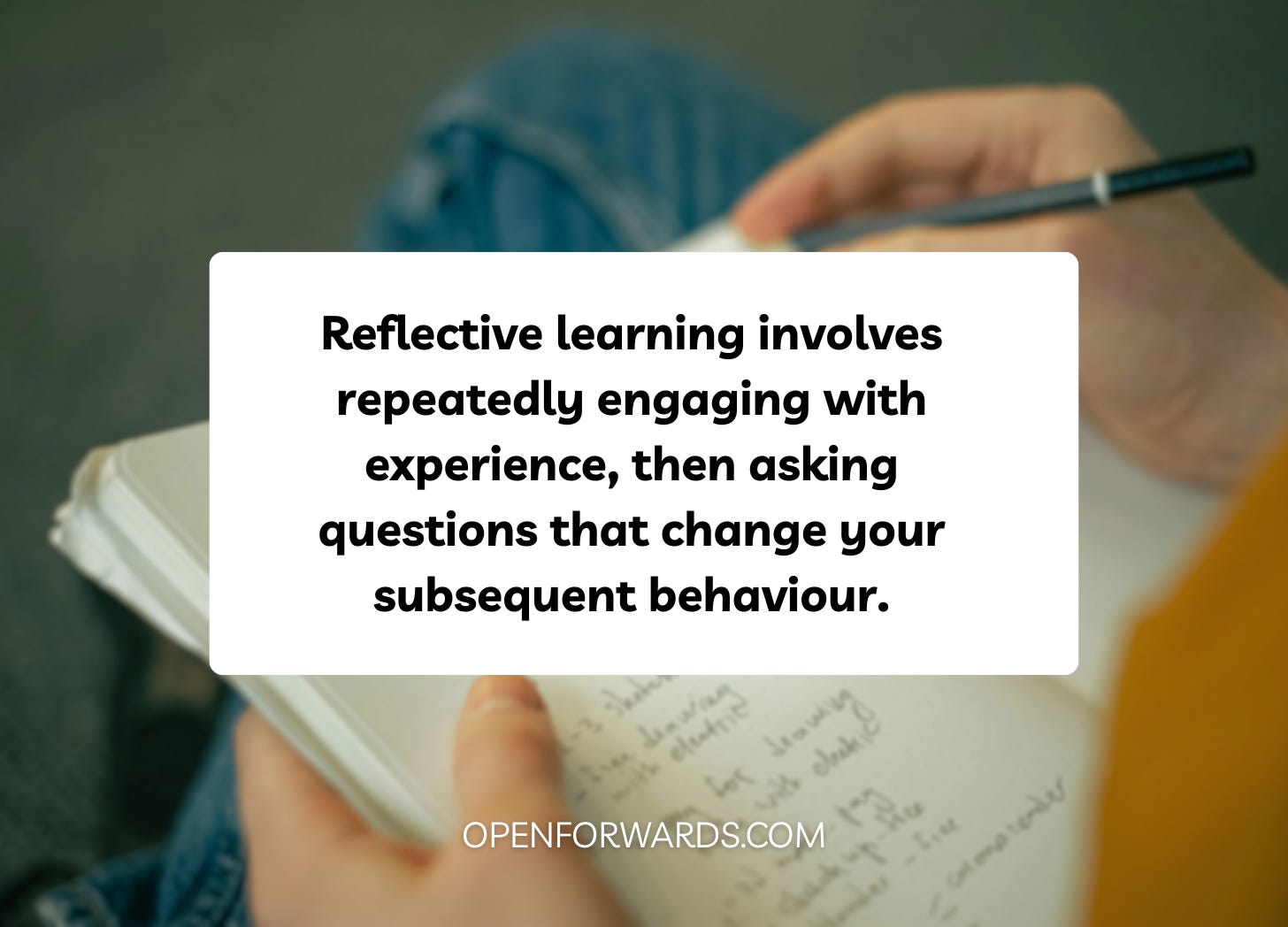
Reflective learning involves repeatedly engaging with experience, then asking questions that change your subsequent behaviour.
That definition matters because it keeps reflection tethered to functional contextualism:
Behaviour happens in context.
The unit of analysis is the act-in-context (including private events).
We track function and workability.
We care about prediction and influence in the service of values.
So, reflection becomes less about “What’s wrong with me / the client / the session?” and more about:
What patterns showed up?
What were the contextual cues?
What did those patterns achieve in the short term?
What did they cost?
What small experiment could increase flexibility?
A brief example
A therapist I know (let’s call them Sam) was working with a client who repeatedly reported feeling “stuck,” overwhelmed, and unmotivated. Sessions felt supportive, warm, and… circular.
Sam’s initial story was: “This client is very fused and avoidant.” Which may be true. However, it is not yet a map.
In reflection, Sam asked:
What did the client do in session when emotions got close?
They intellectualised. They narrated. They analysed.What did I do?
I joined them. I asked thoughtful questions. I “processed” with them.What happened next?
The session felt supportive, but no new behaviour emerged. The client left feeling lighter but continued to repeat the same patterns.What function might my responses be serving?
I might be reinforcing “talking about feelings” as a way to avoid feeling them and taking values-based action.What function might this be serving for me?
It keeps the session safe. It reduces my own discomfort with fear, embarrassment, and uncertainty. I avoid the risk of upsetting, angering, or shaming my client. And, I control the risk of feeling like a failure.
That last line is where reflection illuminates, because it includes the therapist as context.
Sam’s next-step experiment wasn’t a grand reinvention. It was one small behavioural commitment:
“When the client shifts into analysis, I’ll name the move gently, slow down, and invite 30 seconds of contact with what’s present—tracking willingness and workability. I’ll disrupt the avoidance by asking, What are you hoping for when you tell me that?”
Next week, Sam tries it. The client pauses and becomes curious about their intentions. They say, “If I know why, then we’ll be able to solve the problem.” Sam’s urge to problem-solve arises again. However, Sam stays. They breathe. And they say, “I wonder why we haven’t found the answers yet. How long have you been searching? What has this quest cost you? The client says, “I never thought about this.”
That’s undermining the control. It’s learning from reflection and shaping a more flexible pattern in the room.
Committing to reflection (without turning it into homework hell)
The goal isn’t to write beautiful reflective essays. The goal is to create a repeatable practice that reliably improves your craft.
Here’s a simple rhythm that works well for busy clinicians.
The 10–15-minute weekly reflection
When: same time each week (anchor it to writing your session notes)
Where: one notebook / one doc / one place
How: answer a small set of good questions, then choose one experiment for next week
A helpful format is:
Notice (what happened, behaviourally)
Name (the function/process patterns)
Choose (one workable experiment)
You can do it with your eyes closed first, and then put pen to paper. If you do this weekly, your development becomes less dependent on motivation and more dependent on structure. Which is good news, because motivation is… an unreliable colleague.
Reflective questions: a menu for ACT practitioner development
Below is a set of reflective questions designed specifically to:
orient to behavioural processes
assume functional contextual principles (context, function, workability),
include therapist-as-context, not only the client’s world.
You don’t need to answer all of them. Pick a few per week.
A) Functional mapping questions (pattern > story)
What was the main behaviour-in-context we were dealing with (client and therapist), described as concretely as possible?
What did the client’s behaviour do in the moment (short-term consequences)? What has it cost long-term?
What did my behaviour do in the moment (for the client, and for me)?
What contextual variables seemed to set the occasion (sleep, stress, relationship events, cultural context, therapy frame, my pacing/assumptions)?
If I had to name the maintaining loop in one sentence, what would it be?
B) Workability and values questions (direction > symptom focus)
What would “workable” mean for this client, in this context, this week?
What values direction was present in the room (spoken or implicit)?
What did we build today that supports a life bigger than the problem?
Where did I (subtly) privilege comfort over courage? Where did I support courageous movement?
C) Therapist-as-context questions (you are part of the system)
What showed up in me (emotion, urge, story) that shaped the session?
What did I avoid contacting? What did I overdo? What did I control?
When did I lose my rhythm (speeding up, explaining too much, rescuing, distancing)?
What did my tone, pacing, posture, or facial expression teach about discomfort?
What reinforcers might I have offered (relief, reassurance, certainty, approval)? Were they in service of values or avoidance?
D) Process choice questions (precision > “doing ACT generally”)
Which psychological flexibility process(es) were most relevant in the moment, and what evidence did I use to decide?
Did I target a process, or did I get pulled into “content debate”?
Where was the leverage point that I missed?
If I could replay 90 seconds, what would I do differently, and what process would that serve?
E) Deliberate practice questions (learning loop > vague intention)
What is one micro-skill I want to train next week (e.g., evocative questions, shaping willingness, tracking rules, values language, functional links)?
What would “1% better” look like in observable therapist behaviour?
What feedback will I seek (from client behaviour, outcomes, my supervisor/peer, session review)?
What will I repeat on purpose?
F) Meaning-making questions (integrate experience into wisdom)
What did I learn about human suffering (and courage) this week?
What assumption got challenged—in a good way?
What do I want to keep doing because it fits the therapist I want to become?
What would a kind, realistic training mindset sound like right now?
A simple template you can copy into your journal
My weekly ACT therapist reflection (10–15 minutes)
One moment I’m proud of (what I did, behaviourally).
One moment, I got pulled into a struggle (what happened in me).
The main pattern I noticed (function-in-context).
The leverage point I want to target next (process + purpose).
One experiment for next week (tiny, trainable, specific).
One sentence of kindness to myself (because shame is not a training plan).
Reflection is a commitment to the craft.
Not as another thing to “keep up with,” but as a way to keep your practice alive—responsive, precise, and human.
It’s how you learn from what actually happened, rather than from what you wish had happened.
It’s how you stop merely having sessions and start deliberately shaping your development as an ACT practitioner.
And—quietly, importantly—it’s how you keep therapy a creative collaboration and build behavioural patterns that move people toward meaning.
Advanced ACT Training Programme (starting at the end of January)
Reflective journaling is a core part of my Advanced ACT Training Programme, because it’s one of the most reliable ways I know to turn experience into measurable improvements in presence, precision, and clinical impact.
The next cohort starts at the end of January 2026, and I currently have three places remaining.
If you’d like to explore whether it’s a fit, please read the information page and book a discovery call.